The following is a term paper I wrote for my technical writing class. I do not have a strong opinion about the subject, but I "took a side" in order to play advocate and encourage conversation on this confusing subject.
Hope you enjoy!
ART VIDEO GAMES
By Raymond
Skinner
In the last few years, there has
been much discussion and controversy on the growth of video games in our
society. The recent trends in technology
have changed video games in ways that people 10 years ago would have never
conceived. This evolution in technology
has allowed video games to implement complex artificial intelligence, immense
three dimensional environments, and has given way to allow artists to express
themselves in the game industry. However,
one thing remains about games that will never change. Video games are not art. They can convey meaning, evoke emotions, and
can even be a medium in which artists can express themselves, but the fact
remains that games are systems with rules and goals. Artificial intelligence
has no emotion, it is a precompiled list of responses to pre-determined
instances.
The definition of art is, “The
expression or application of human creative skill and imagination, typically in
a visual form such as painting or sculpture, producing works to be appreciated
for their beauty or emotional power”. 1 At first glance many video
games seem to fit the definition of art very well. Video games seem imaginative, it is obviously
in visual form, hence the use of the word video in describing the type of game,
and many games are very much appreciated for their emotional power or beauty. What we are seeing is not video games as art.
Instead, what we are seeing is art expressed using video games. A game is a
system, a set of rules and well calculated outcomes. Our ever evolving technology simply allows
artists to express themselves in this system, but the system itself is not art.
Saying video games are art, would be like saying a pencil and paper are art.
Sure, someone can pick up a pencil and express themselves in ways that can only
be expressed by drawing on paper, but that doesn't make the pencil and paper
art any more than a system of defined rules such as a game can be declared art.
For
instance, a painting hanging on the wall may be art, but one wouldn't say the
frame holding the painting is art. The
maker of the frame may have taken great care to make the frame beautiful, but
this is done in craft. The frame is a
structure. Structure in itself is the
opposite of art, structure takes careful planning, a desired outcome, and does
not express emotion. Structure is
logical. In the instance of the frame,
its desired outcome was to hold the painting up and preserve its form so that
the art can be viewed by others. In this
same way video games are the structural support for the artists who operate in
these games.
Roger
Ebert said in his article Video Games Can
Never Be Art, "One obvious difference between art and games is that
you can win a game. It has rules, points, objectives, and an outcome."2
Ebert was a film critic for the Chicago Sun-Times from 1967 until his death in 2013. His reviews were in over
200 newspapers across the world, most of them in the United States and he
published over 20 books.3 Ebert makes a great point that a game by
definition has rules and objectives.
Anything that may be referred to as a video game without rules and
objectives, without an outcome, is inherently not a game. It may be a work of interactive art, it may
even be fun, but without rules it cannot be declared a video game.
Brian Moriarty, a Professor of
Interactive Media and Game Development at Worchester Polytechnic Institute, was quoted at
the Game Developer’s Conference in 2011 stating this, "How can an activity motivated by
decisions, striving, goals and competition, a deliberate concentration of the
force of Will, be used to transcend Will itself? You might as well try to smother a flame with
oxygen." He goes on to say, “In my
Digital Game Design I class, I define "play" as a superfluous
activity. I define a "toy" as
something that elicits play, and a "game" as a toy with rules and a
goal. Games are purposeful. They are
defined as the exercises of choice and will towards a self-maximizing
goal. But sublime art is like a toy. It
elicits play in the soul. The pleasure
we get from it lies precisely in the fact that it has no rules, no goal, no
purpose."4 Professor Moriarty’s definition of a “game” as a toy
with rules and a goal, was a perfect example that games in nature are not
art. A toy is meant to be fun, they can
encourage our own imaginations and inspire us to create works of art. Toys can even involve a work of art, or
perhaps an original idea to design that toy was based on an artist’s conception
but it remains a toy.
A
game is designed to respond to interaction and gives the player ownership over
the outcome. Giving the player ownership
over decisions and interactions, takes away any authorship the creator may have
had. The experience that the player has
is based on the decisions that he makes during the game. Some argue that linear style games are art
because the author gives no option to the player to alter the story and have
their own experience. The fact is, this
is wrong. Yes, in these linear games,
there is an obvious path and there is an author behind the story that wants the
player to experience a certain outcome, but the game itself lends the player
choice. Even if that choice is to run
off a ledge and end the turn, or simply the option to retry the level or quit
the game takes the authorship out of the hands of the author and puts it in the
hands of the player. Therefore, even
strongly linear games, because they are games by definition they cannot and
will not ever be art. Once a developer
crosses that line, once he makes the decision to completely remove any
authorship and choice from player, the experience can then be truly determined
if it is art or not. By doing this,
however, the developer can no longer call this a video game. With no objectives or goals, no options, no
competition, no control it is simply no longer a game. Without play, there is no game.
Video
game design has evolved. The process,
technology, and depth of games have become more and more complex. Video games can do more now than they ever
could and the fact that this evolution has incorporated art into these systems
has changed the world of artificial intelligence and virtual reality in ways
that could not have been conceived. The
involvement of art in video games is the reason the discussion of games as art
has arose. The confusion of the subject is mostly due to the lack of knowledge
that people have about video games. Most
people see what’s on their televisions, phones, computer screens and they see
the art. They see the beauty that lies within these systems. What they don’t see on the surface is that
behind these works of art are a set of rules and loops, also known as the game
engine. Even though these have always existed
in games, with the graphic intensity of most games developed during this era,
many people do not understand that what they are really seeing is art work
supported by an engine of complex code.
In the same way a car has an engine, a chassis, and a body, video games
have similar components. The body is not
the car, rather just the outer shell that everyone can see. In a similar way, the art on the screen is
not the game, it’s just the part that everyone can see. Behind this art is the engine that moves the
game, gives the player control. The game
is not art, even though art is obviously present in the game world. Without the game the art wouldn’t be brought
to a screen and it may not even exist.
Here is an example of the classic game Tetris:

Notice that the above game has very little
graphical interface, and absolutely no art.
Below I have included an image of the new Tetris game, Tetris
Party. The game itself has very little
difference in the rules or the game play and the main objective remains the
same as it did in when the game was originally created. Notice that the game looks completely
different. There is much art on the screen.
From the blocks themselves to the background, art is very apparent in
this game. Although the game seems to be
more “artistic” it is still a game, with rules and a goal. This game is not art, but a vessel in which
the artist can portray his art to an audience.
Another
example of a game that has adapted art into its interface is Dungeons and
Dragons. Below is a picture of a
character sheet from the pen and paper, tabletop version of Dungeons and
Dragons. The game has a plethora of
rules and attributes, and lends much authorship to the player. There is no art in this pen and paper game,
the player’s must use their own imaginations to truly engage in a role playing
environment.
The game developer Turbine inc, has
designed a game based on these same attributes and rules. The game is called Dungeons and Dragons
Online. Dungeons and Dragons Online
(DDO), is a very rich graphical experience.
There were many artists involved in the development of the game and lends
itself as a great tool for artists and players alike to express themselves in
this environment. However, the game
still relies on the same rules and attributes as its pen and paper counterpart
and even adds an entirely new set of complex rules for gameplay. DDO remains a game, and even though a great
experience with fantastic art, it is not art.
Below I have included a screenshot of the game.
im Munroe interviewed with Nora Young in 2010
for the Canadian radio show Spark. During the interview Young revealed
her opinion that video games are more closely comparable to the design of
architecture where the designer creates a virtual environment.5
Architecture isn’t art, it is engineering.
Developing these three dimensional and two dimensional worlds takes a
great deal of skill and engineering, similar to architecture. There is a term used to describe games with artistic style and
meaningful plots, as “art games”. The
term art games is contradictory, because a game can’t be art, and art isn’t a
game. The meaning of the term seems to fluctuate between discussions on the
internet. Some of these discussions being about games with great art in them. Others
may be about games that give the player a meaningful experience. It’s a good thing when games can convey
meaning because it shows that a game can be used for educational purposes,
however calling a game that has purpose “art” is incorrect. The meaning may have come from an element in
the plot that told a story, and that story may have been art. Telling the story
was a game objective, the meaning that was conveyed was invoked by the game
mechanics. This is in the same way that
graphic art is conveyed in games, the player has to play the game to see the
art but that doesn’t make it an art game.
Tale of Tales gave a presentation at
the Art History of Games in 2010, during which they stated, “People have been
playing games for as long as they have existed. Even animals play games.
Lifeforms with brains seem to have a need for playful behaviour. The reasons
for this might be medical, psychological or social.” And goes on to state, “Art, on the other hand
is not born out of a physical need or an animal instinct. Art is born out of a
desire to touch the untouchable. To explore the unknown… There are no rules in
art that cannot be broken. There's no goal that does not evaporate as soon as
it is discovered. Art enables us to see the mystery in the mundane and to
recognize the unfamiliar. Art is a conscious act of an author who seeks to
communicate with an audience in a language without grammar, in a structure that
is undefined with no predetermined goal and no rewards but finding yourself.”6
During the same presentation the company also revealed its opinion about the
industry stating, “Despite a few noble attempts, overall, videogames are empty
systems that only serve the purpose of wasting time. For a small subset of the
population, this is more than enough. But the rest of us wants a bit more, or
simply something different.” I have
included two of the images given along with this presentation below:
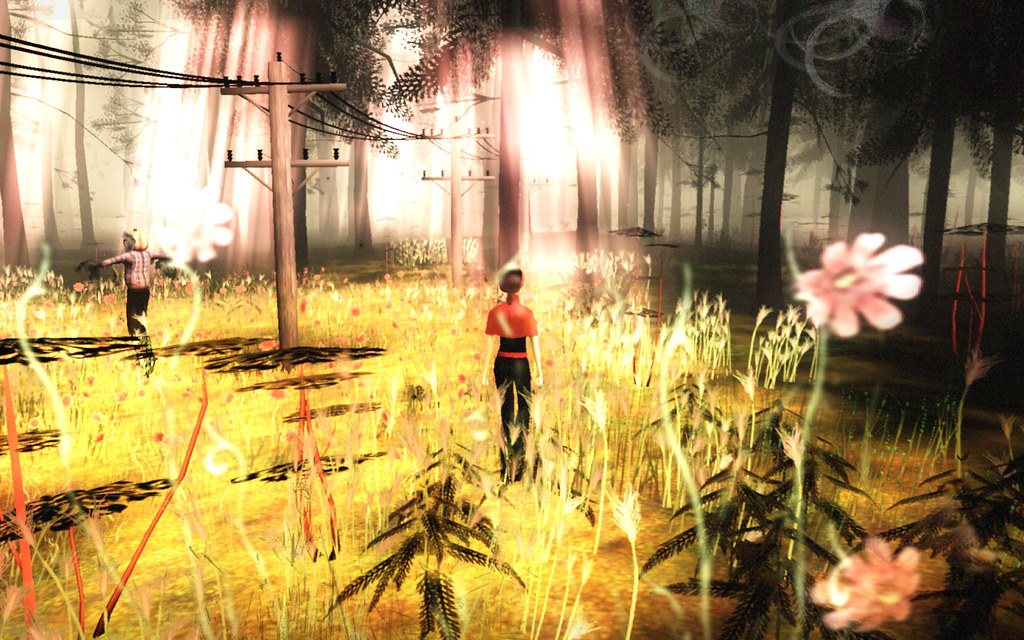
Tale of Tales is a company who has made games that many have
proclaimed as art games and yet the company itself denies that logic. Below is a screenshot from their game The Path. This game is one of the many
games that are included in the category falsely defined as art games.
Video Games involve many different
kinds of art such as written stories, two dimensional and three dimensional
graphic art, and music. Art would not be
where it is today if it were not for video games. The evolution in games has not only opened
the way for artists to express themselves, but has created an income stream for
many creative types. Art in games is by
far the most advanced, detailed, and photo-realistic creative work out
there. Even the “art games” movement,
although contradictory by definition, has stirred up a great deal of art in the
field of game design. However, unless
the definition of art or the definition of game changes, video games are not
and will never be art.
BIBLIOGRAPHY
1. Definition: Art, Oxford
English Dictionary, Oxford University Press, 2013.
5. Nora Young & Dan Misener, “Games as Art”, Spark, October, 2011.